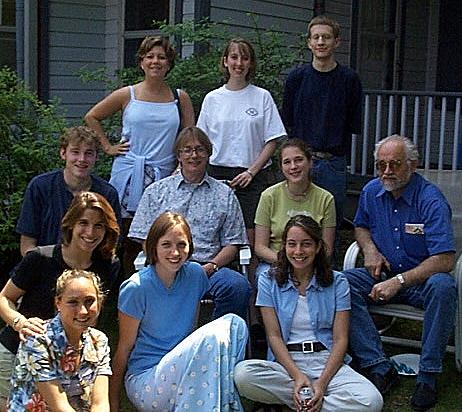
 Here's
some of the class from Spring 1999, along with Jaak Panksepp (far right),
at an end-of the-year picnic at the Siviy house.
Here's
some of the class from Spring 1999, along with Jaak Panksepp (far right),
at an end-of the-year picnic at the Siviy house.
The goal of research in behavioral neuroscience is to understand behavior in terms of the neural substrates that are responsible for the orchestration of those behaviors. It is the primary purpose of this course to give the student hands-on experience in the field of behavioral neuroscience and, hopefully, provide some of the knowledge and empirical skills which will facilitate the design and execution of research in this field.
The specific content of the course changes each time it is taught, although
the general objectives mentioned above remain the same. For the last
semester in which this course was taught (Spring
1999), we spent the first several weeks of the semester looking at
a particular behavior ( rough-and-tumble play
in juvenile rats ) and how one neural system (mesolimbic dopamine)
might be involved in that behavior. We then take a broader look at the
brain's involvement in emotions by reading and discussing selections from
Jaak Panksepp's book on Affective Neuroscience. To complement what we were
covering in class and to give some bearings on what was possible within
the constraints of our resources, we did an initial experiment as a class
which looked at the effects of lesioning a particular brain area on play
behavior in the rat. In this study, students were able to participate
in a procedure wherein the dopamine neurotoxin 6-hydroxydopamine was surgically
administered into the nucleus accumbens of juvenile rats. After a
recovery period, the play behavior of lesioned rats was assessed when paired
with control animals. While all this was going on, students (who
were divided into groups of three) came up with a testable hypothesis of
their own and spent the rest of the semester testing these hypotheses.
Here's
some of the class from Spring 1999, along with Jaak Panksepp (far right),
at an end-of the-year picnic at the Siviy house.